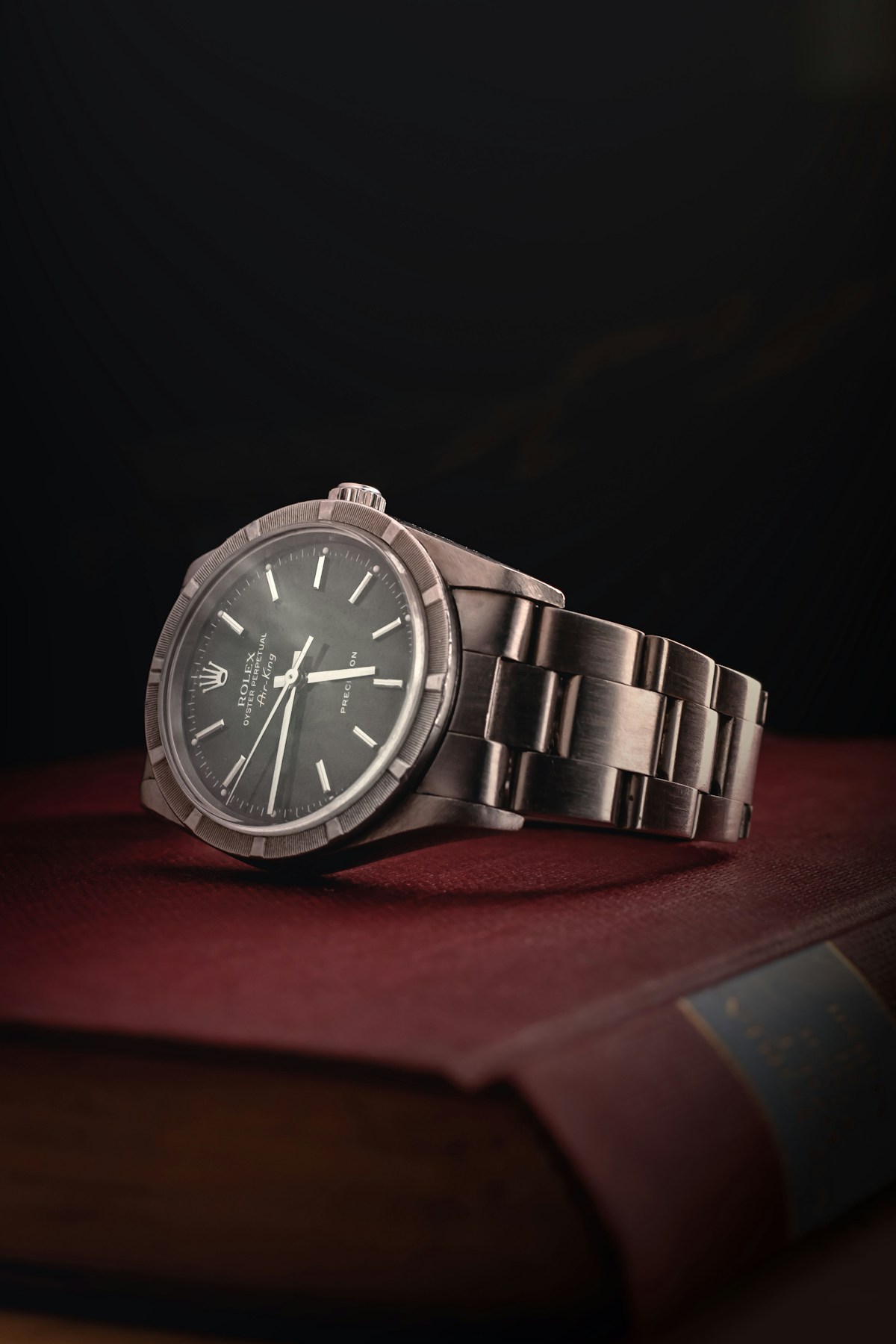
Ten years ago, vintage Rolex sat at the margins of the collector world. Watch Twitter was still a fringe subculture. The term "grail" hadn't yet been drained of meaning. You could still buy a Paul Newman Daytona for under $100,000 and a meters-first Submariner 5513 for under $15,000.
That window closed somewhere around 2019 and has never reopened. What's happened since is a structural repricing of the category — and, for those paying attention, a set of still-undervalued references that will define the next decade of collecting.
The market has matured. The returns are smaller. The floor is significantly higher. And the opportunity is now in selectivity, not speculation.
What's Changed Since 2019
Three structural shifts have redefined the vintage Rolex market. Understanding them is prerequisite to making good decisions in 2026.
First, the information asymmetry has collapsed. When Phillips launched the Geneva Watch Auction in 2015 and started publishing condition reports at forensic detail, the gap between "dealer knows" and "collector knows" narrowed permanently. Dial fonts, case serial ranges, bezel variations — all of it is now searchable. The days of buying a transitional Submariner from a grandfather's estate for $8,000 and flipping it for $40,000 are essentially over.
Second, condition has become binary. For the top 10% of references, unpolished cases with original dials trade at 3-5x the price of comparable pieces with service dials or polished cases. This premium was 1.5-2x a decade ago. The market is now paying exclusively for originality, and the gap is widening.
Third, the buyer base has shifted from enthusiasts to allocators. Family offices, watch-as-asset-class funds, and collectors who view vintage Rolex alongside fine art and classic cars are setting prices at the top. The implication: hype cycles are shorter, but structural floor prices are firmer.
The References That Matter in 2026
Some categories remain overvalued relative to their long-term trajectory. Others — despite the general market repricing — are still structurally undervalued. Our specialist editors see the 2026 opportunity in four specific zones.
01 · The Paul Newman Daytona (6239, 6241, 6262, 6263, 6265)
Still the most iconic. Still the most overexposed. The 6239 in tropical brown has reached near-asymptotic pricing. But the 6263 and 6265 screw-down pushers, particularly in silver dial / black sub-register "Panda" configurations, remain 20-30% below their quality-equivalent 6239 counterparts despite being objectively rarer. This is a categorical mispricing. Expect it to correct over the next 24-36 months.
Key diligence point: insist on original "mark 1" Paul Newman dials with proper step-dial architecture. Re-printed dials — even period-appropriate ones — trade at a 70% discount and should not be conflated with originals under any circumstances.
02 · The Submariner 5513 (specifically, meters-first, tropical, and gilt)
The 5513 was produced from 1962 to 1989, which means there are many of them. The 2026 opportunity is specifically in pre-1967 meters-first examples with intact gilt or matte tropical dials and unpolished cases. These are now the entry point to serious vintage Rolex collecting, and they remain the most underpriced grail category by almost any metric.
A fully documented, unpolished, meters-first 5513 with original bezel insert and owner's papers should trade in the $45,000-$75,000 range in 2026. The fact that similar-condition 5512s routinely exceed $150,000 tells you exactly how much ceiling the 5513 still has.
03 · The GMT-Master 6542 (Bakelite bezel, gilt dial)
Produced 1954-1959, the 6542 is the first Rolex GMT. Its defining feature — the translucent Bakelite bezel — is also its weakness: most originals cracked and were replaced under service, leaving perhaps 15% of surviving examples with their original bezels intact. Those that remain are structurally scarce in a way that won't change.
Current market price for a 6542 with original Bakelite bezel and gilt dial: $250,000-$400,000 depending on condition. Fair value in 2028: we project $500,000-$750,000 as the top 10% of survivors are absorbed into permanent collections.
04 · The Sea-Dweller 1665 Double Red
Perhaps the most interesting contrarian play. The 1665 with "Double Red" dial (two red lines of text) has been a collector favorite for years but has failed to achieve the headline prices of the Submariner references. At current levels — $55,000-$120,000 for clean examples — it represents one of the best risk-adjusted entry points into serious vintage Rolex.
What We Would Avoid
Three categories we see as structurally overvalued:
Modern-production "vintage-style" references trading at grey-market multiples. The Daytona 116500LN at $40,000+ is not a vintage watch. Collectors conflating the two will be disappointed in five years.
Heavily-serviced or polished vintage pieces at "value" pricing. A polished case cannot be unpolished. A service dial cannot become an original. These pieces have a ceiling that won't move meaningfully.
Undocumented "tropical" dial conversions. Dial coloring has become susceptible to artificial aging. Without papers, provenance, and — ideally — an Extract from the Archives, stay away from anything claiming unusual dial coloration.
The Practical Advice
For collectors building a serious vintage Rolex position in 2026, our curators advise three rules:
- Buy condition, not reference. A 95%+ condition 5513 is a better investment than a 70% condition 1655.
- Require paper trail. Original warranty booklet, punched papers, Service Card, and provenance documentation should be non-negotiable above $50,000 purchase price.
- Use specialist dealers, not marketplaces. The condition spread on the same reference between a specialist dealer and an online marketplace is typically 15-30% in favor of the specialist — and the warranty and authentication protections justify the premium.
A Final Word
Vintage Rolex is no longer a collectors' secret. It is now a recognized alternative asset class, priced accordingly by a global buyer base. But within that repriced market, structural mispricings still exist — and the collectors who identified them five years ago are the ones we're advising today on which references to hold, which to harvest, and which to add.
If you'd like a review of a specific reference or a private conversation about building a vintage Rolex position, our concierge team is available.
This article reflects editorial opinion and is not investment advice. Market conditions evolve, and past performance does not guarantee future returns. All acquisitions should be evaluated with qualified specialist counsel.